

Photo engraving is one of the most demanding things you can ask of a diode laser. Fine gradients, subtle transitions, and consistent dot placement all need to come together to produce a clean, realistic result. There’s also a long-standing bit of “shop lore” that claims higher-power diode lasers sacrifice detail due to larger spot sizes.
We decided to test that claim directly.
In this article, we’ll first walk through what actually matters for diode laser photo engraving, then share the results of a controlled engraving runoff test using four different J Tech diode lasers — from 7W all the way up to 64W PRO.
What Makes a Good Diode Laser Photo Engraving?
Photo engraving is not about brute force — it’s about control.
Key factors that affect photo engraving quality include:
1. Spot Size & Beam Quality
Detail resolution is governed primarily by:
- Optical design
- Beam shaping
- Focus accuracy
Power alone does not determine spot size. A well-designed high-power diode system can maintain a comparable effective spot size to a lower-power unit when operated correctly.
2. Motion Consistency
Consistent feed rates and acceleration are critical for:
- Uniform dot spacing
- Clean dithering patterns
- Avoiding banding or streaking
3. Software Settings
For this test, we standardized everything in LightBurn:
- Dither Mode photo engraving
- 0.005″ line interval
- 100 inches per minute
- Identical project file for every laser

4. Material Variability
Wood is organic and imperfect. Grain direction, glue layers, and surface flatness all introduce variation — especially with plywood.
The Test Setup
To remove as many variables as possible, we ran a controlled runoff test using the same project file and engraving settings across four different J Tech diode lasers.
Lasers Tested
- 7W+
- 14W+
- 34W PRO
- 64W PRO
Engraving Settings (Identical for All)
- LightBurn Dither Mode (Photo)
- Line Interval: 0.005″
- Speed: 100 IPM
- Same image file for every run
Power Levels Used
Power was adjusted only to achieve similar overall image darkness:
| Laser | Operating Mode | Power Setting |
|---|---|---|
| 7W+ | Full | 60% |
| 14W+ | Full | 40% |
| 34W PRO | Half Mode | 20% |
| 64W PRO | 24W Mode | 12% |
Material
- 12″ x 12″ Baltic birch plywood
- Purchased from Amazon
- Not perfectly flat (significant warp)
About the Project Image
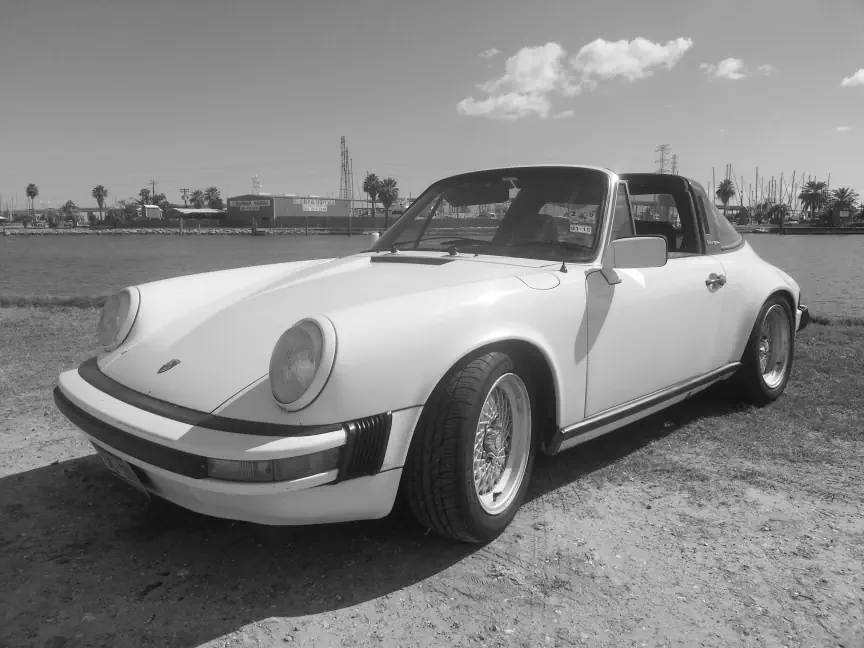
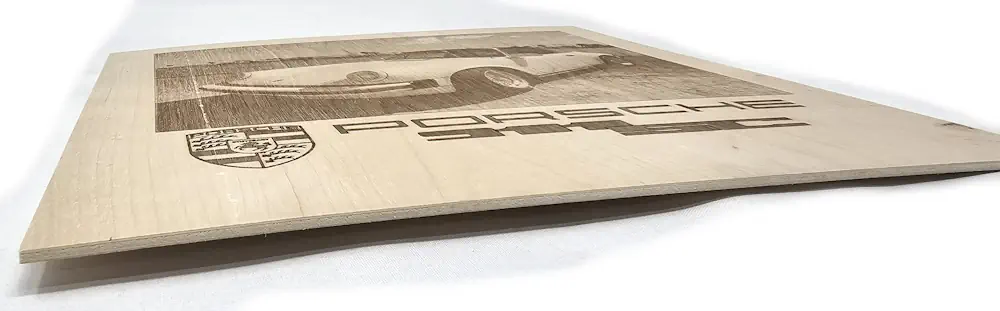
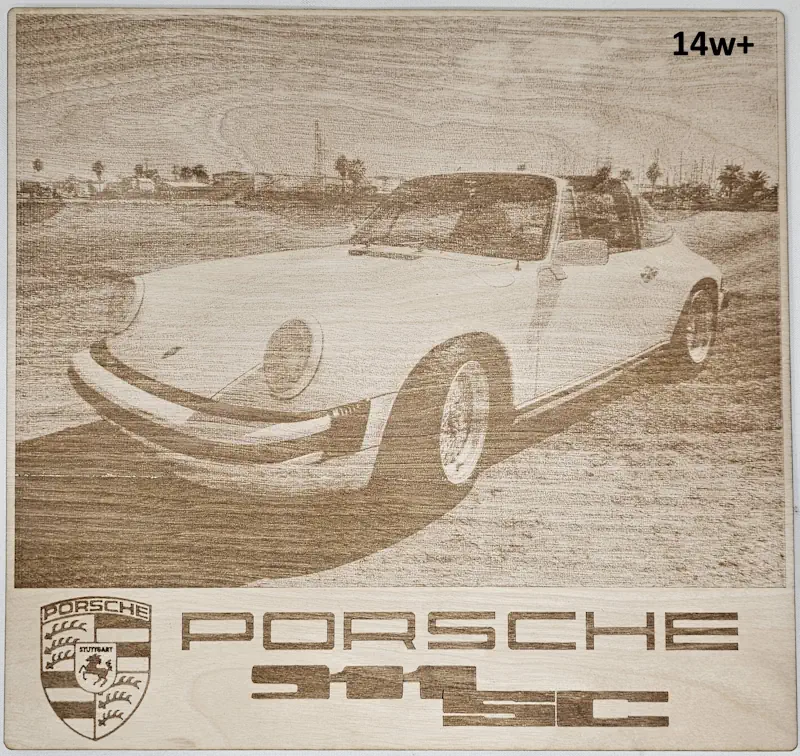
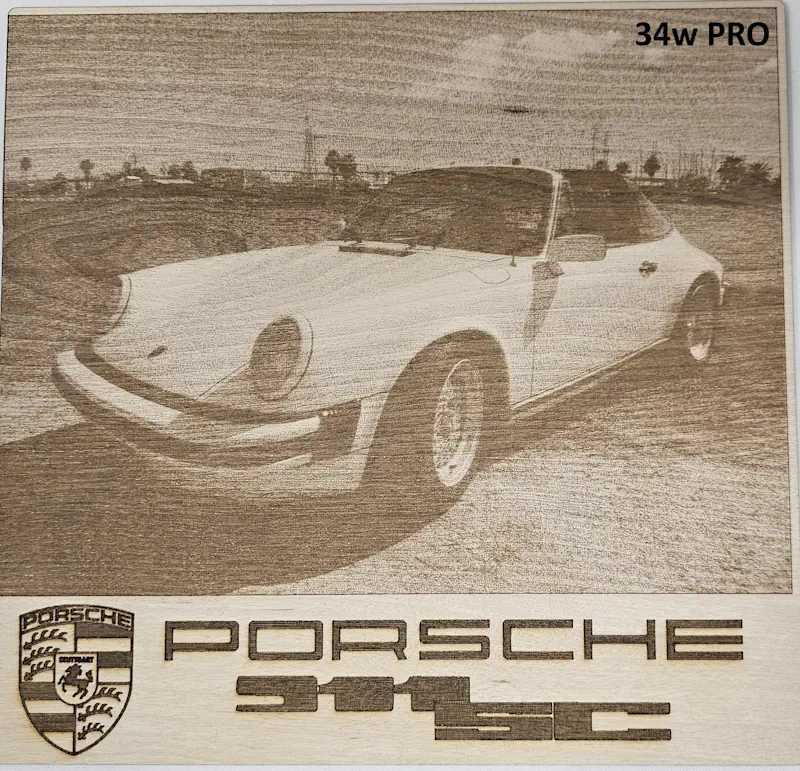
The engraving file was a photo of a 1980 Porsche 911 Targa SC, paired with a clean Porsche logo engraved beneath the image.
This type of project is ideal for evaluating:
- Fine detail retention
- Gradient smoothness
- Edge clarity
- Dither consistency
Focus Challenges (And Why They Matter Less Than You Think)
Because the plywood was warped, maintaining perfect focus across the entire engraving area was impossible. In some cases, we had to physically raise the laser module to compensate — especially on the 7W+.
Focus heights used:
- 7W+: 0.125″
- 14W+, 34W PRO, 64W PRO: 0.25″
In reality, focus shifted slightly during engraving due to material unevenness. Despite this, all four engravings still produced excellent photo results, which is a strong indicator of optical consistency across the lineup.
The Results: Do Higher-Power Lasers Lose Detail?
Short answer: No.
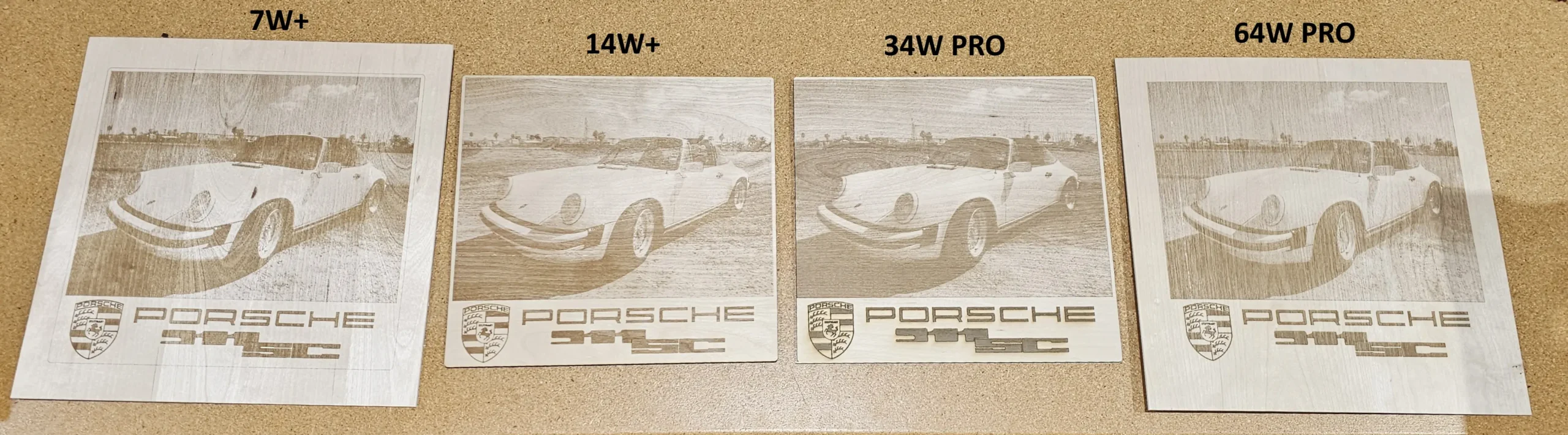
Despite the common belief that higher-power diode lasers inherently have larger spot sizes and reduced detail, our results showed:
- Equivalent fine detail across all four lasers
- Clean dithering and dot placement at every power level
- No noticeable loss of resolution on the 34W PRO or 64W PRO
- Minor darkness differences attributable to power tuning — not optics
Any small variations observed were overwhelmingly due to:
- Wood grain direction
- Glue layers in the plywood
- Localized focus variation from warp
With additional tuning time, we could have matched darkness nearly perfectly across all samples.


What This Means for J Tech Customers
This test reinforces a key point:
Higher-power J Tech diode lasers do not sacrifice photo engraving detail.
Instead, higher power gives you:
- Faster throughput when needed
- More flexibility across materials
- The ability to dial power down for photos and up for cutting
You’re not choosing between detail vs power — you’re choosing range and capability.
Final Thoughts
Photo engraving is one of the best ways to showcase the precision of a diode laser system. In this test, every J Tech laser — from 7W+ to 64W PRO — delivered excellent results using the same file, same settings, and imperfect real-world material.
That’s not an accident. It’s the result of careful optical design and consistent beam quality across the product line.
Whether you’re engraving family photos, artwork, logos, or detailed graphics, a properly tuned J Tech diode laser will deliver the detail you expect — regardless of wattage.